Somewhere around the fourth or fifth time you haul a hi-lift jack out of a plastic tote that has slid across the cargo floor and dumped itself into the wheel well, you start to understand what a rail kit is actually for. It isn't about looks. It's about the fact that a Wrangler's tub is a big smooth box with almost nothing to tie anything to, and every loose object in it becomes a projectile the moment you hit washboard gravel at speed.
That's the pitch, and it's a real one. But here's where most Jeep owners get confused before they even spend a dollar: there are at least three different things people call a "rail kit," and they don't do the same job. Get the terminology straight first, or you'll buy a bed rail for a rig that needed a cargo-floor track.
Key Takeaways
- A "riding rail kit" usually refers to a cargo-floor track or slide system, not a roof rail or a bed rail. Confirm which one you're buying.
- Factory trail rail systems exist on some trims; aftermarket kits exist for almost everything else, including older TJ and JK models.
- The best customization ideas are functional first. Mount points, tie-downs, and slide-out drawers beat decorative add-ons every time.
- Bolt-on installs are typically a couple of hours with basic hand tools. Anything requiring drilling into the tub is a weekend job and a commitment.
- Load ratings matter more than aesthetics. A rail that flexes under a loaded fridge is worse than no rail at all.
Riding rail kit customization, explained without the marketing noise
The confusion starts with language. Jeep's own factory accessory on certain trims is often called a "trail rail" or "cargo management system." Community forums call the same thing a "bed rail" on the Gladiator. Meanwhile a "roof rail" is a completely separate animal that lives on top of the hardtop. And then there's the thing you're actually asking about: a riding rail kit—a low-profile track that bolts to the cargo floor or the sides of the tub and gives you a moving anchor point for everything else.
Look, the difference matters. A roof rail holds weight over your head. A cargo-floor riding rail holds weight at the bottom of the tub, which is exactly where you want heavy recovery gear, jerrycans, and a fridge. The rail itself does almost nothing. It's the ecosystem of brackets that slide and lock onto it that does the work.
What actually comes in a kit
A typical kit ships with two or four extruded aluminum or steel tracks, end caps, and a set of mounting fasteners. Sometimes you get a couple of sliding tie-down rings thrown in. What you almost never get is the fun part—the purpose-built brackets that turn a bare rail into a system. That's the customization layer, and it's where owners either get creative or waste money.
- Sliding D-ring tie-downs for straps and nets
- Quick-release mounts for a hi-lift or bottle jack
- Slide-out drawers or a single full-width tray
- Integrated LED strip lighting wired to an accessory switch
- Modular dividers that section off the tub into zones
- Camera mounts, both for trail footage and for backing up a trailer
Notice that list isn't five items of equal length or shape. That's deliberate—because in practice, your build won't be symmetrical either. You'll have two heavy functional anchors and three small conveniences, and that's fine.
Customization ideas that actually earn their place
The temptation is to bolt on everything. I've watched people spend $900 on clamps and brackets for a rig they wheel twice a year. Resist that. Here's the order I'd build in, from cheapest-return to highest.
Start with tie-down density, not gadgets
More anchor points almost always beats one clever anchor. Two rails running the length of the tub with six sliding rings gives you the ability to secure a cooler, a fuel can, a duffel, and a tool roll without anything touching anything else. That's the whole point. If your gear can't shift, it can't break.
Then add one slide-out element
A single sliding tray or drawer changes how you load the vehicle more than any other mod on this list. It pulls your heaviest item to the tailgate where you can actually reach it, instead of making you climb into the tub on your knees. For anyone over forty, this is not a luxury.
The catch? Slide mechanisms eat vertical space. Measure your tub depth before you commit, or your fridge lid won't open.
Lighting the rail itself
An LED strip bonded along the underside of the track, wired through a relay to a switch, turns the cargo area from a black hole at night into something you can work in. It's a small job—maybe an afternoon—and it's the kind of thing that makes you wonder why it wasn't there from the factory.
Which kits fit which Jeep, and why the year matters
This is where the SERP snippets you've probably already read fall apart. Nobody tells you that a kit designed for a JLU floor pan won't drop into a JK without adapter plates, or that the Gladiator's bed rails are a totally different width from a Wrangler's tub tracks. Generations diverge fast.
| Model | Rail type commonly used | Install difficulty | Notes |
|---|---|---|---|
| Wrangler TJ (older) | Aftermarket bolt-in cargo track | Moderate | Fewer factory provisions; expect drilling |
| Wrangler JK / JKU | Aftermarket track systems | Easy to moderate | Wide aftermarket support |
| Wrangler JL / JLU | Factory trail rail or aftermarket equivalent | Easy | Factory mounting points on many trims |
| Gladiator | Bed rail / utility track | Easy | Different geometry from Wrangler tubs |
| Cherokee (KL and older) | Light-duty cargo track | Moderate | Crossover interior; check load limits carefully |
If you drive a Cherokee, be realistic. The interior trim and lighter structure mean a rail system there is for organization, not for strapping down a 60-pound recovery bag. Different job, different rating.
What year Jeep to stay away from?
The short answer most mechanics and long-time owners give: avoid the 2007 to early 2011 Wrangler JK with the 3.8L V6. That engine was underpowered for the weight of the vehicle, notorious for consuming oil as it aged, and paired with an automatic transmission that many owners found reluctant and thirsty. It's the generation that gets recommended against most often in purchase-advice threads.
For a rail kit build specifically, this matters because the early JK tub has fewer factory mounting provisions than later models. You're not blocked, but you're drilling, and you're working around a floor pan that wasn't designed with modular cargo in mind. If you're shopping, this is a legitimate reason to look at a later JK or a JL instead—not the only reason, but a real one.
What are some secret compartments in Jeeps?
Every Wrangler generation has a few spots that owners treat as unofficial stash points. Under the rear cargo floor there's often a shallow well where the jack and tools live—on many models there's enough leftover room for a few small flat items. The center console on several generations has a hidden upper tray that lifts out to reveal a deeper bin below. Gladiator owners get the under-seat storage in the rear, which is genuinely useful and not secret at all once you know it's there.
Behind the rear seat back, in the gap between the seat and the tailgate area, there's usually a narrow void. And on models with a fold-down tailgate, the tailgate itself can be modified with an aftermarket panel that creates a locking compartment.
This is where a riding rail kit pairs nicely. If you've got a slide-out tray on a track, the space beneath and behind the tray becomes accessible storage that isn't just a dark hole you have to dig through.
What is the most sought after Jeep Wrangler color?
Ask ten owners and you'll get a split, but the color that comes up most consistently in resale discussions is a mid-tone green—the various shades Jeep has offered over the years under names like Rescue Green, Tank, and Sarge. Orange, particularly the bright shades, has a devoted following and typically holds value well. And white remains the practical favorite because it hides trail pinstriping better than dark colors and doesn't show dust at a distance.
If you're building a rail system and care about the look, here's the honest take: finish your hardware to match your body color or go matte black and stop worrying. Nobody notices anodized accent brackets on a rig that's covered in mud. Spend the money on load capacity instead.
What are some ideas for customizing a Jeep?
Beyond the rail kit, the modifications that deliver the most per dollar tend to be: proper all-terrain tires matched to your actual terrain, a recovery strap and shackles before any cosmetic upgrade, seat covers that survive dirt, and a simple onboard air setup if you air down. Lighting and armor come after. The order matters more than the shopping list.
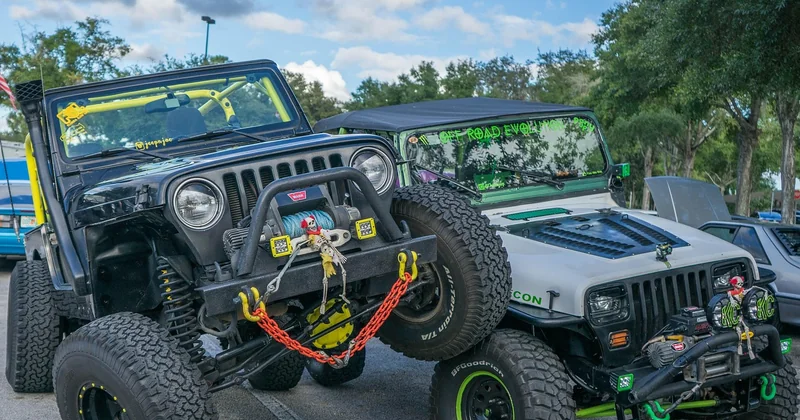
A word of warning on software: the Jeep customizer simulator tools and online configurators are great for picturing a look, and terrible at telling you whether a part fits your specific trim and model year. I've seen people order a bracket based on a visual mockup and discover it doesn't clear the factory subwoofer. Always cross-check part numbers against your VIN, not against a picture.
Install reality check
A bolt-on rail kit on a modern JLU is a two-hour job with a socket set and a torque wrench. Anything that requires drilling into the tub is a full weekend, and you should treat every hole as permanent. Seal them. Rust in a floor pan is a slow, expensive problem.
The mistake I'd flag hardest: over-torquing the track fasteners into thin sheet metal and stripping the threads on the first install. Use the specified torque, use the supplied hardware, and if you're drilling, prime the bare metal before you bolt anything down.
A rail system won't make your Jeep look different to anyone but you. What it will do is stop your gear from rearranging itself on every trail, and after a season of that, going back to a bare tub feels like driving with the doors off in a rainstorm—technically possible, obviously a bad idea.